Monday, January 19, 2026
Home Blog Page 2

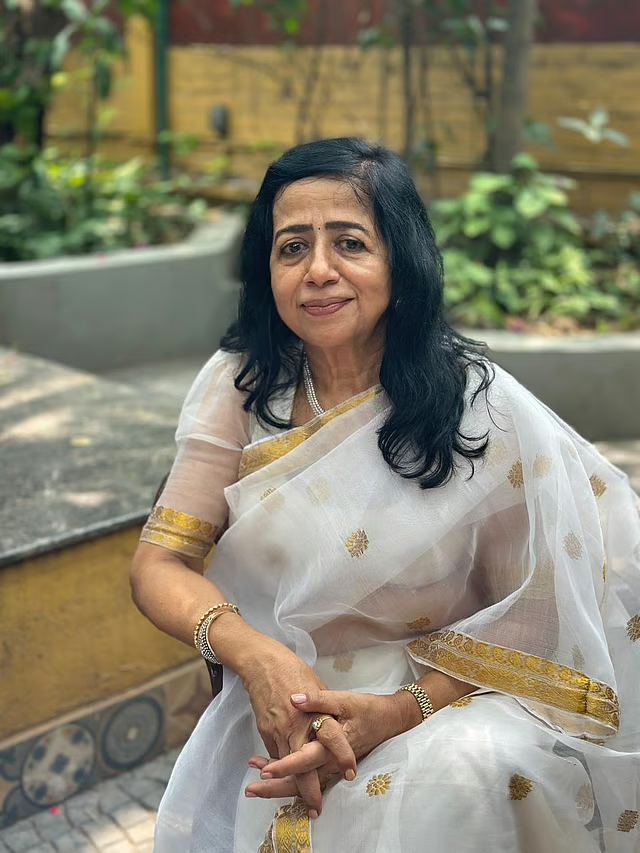
Sangeeta Merchant: Sculpting spaces with soul

0

https://builtbyher.org/

A Journey Rooted in Intuition and Craft

Celebrated Indian architect Sangeeta Merchant co-founded SPASM Design Architects, a Mumbai-based practice she and Sanjeev Panjabi founded in 1995. After graduating from the Mumbai Academy of Architecture, Merchant has over twenty years of experience creating architectural narratives that are both emotionally and materially honest. Instead of using gaudy adornment, her art relies on the power of constraint to create atmospheres that are both poetic and useful. Her contributions to redefining the Indian residential and contextual design language have been often acknowledged in magazines like Architectural Digest India’s AD100.

Design Philosophy: Architecture as a Living Atmosphere

The basic concept of Merchant’s methodology is that architecture is about creating experiences rather than only creating structures. The experiential clarity, spatial fluidity, and ageability of SPASM’s creations are well-known. Merchant focuses on intuitive design techniques, where the materials, sunshine, and even the feel of the land all play a crucial role in the creative process. While embracing simplicity, her architecture never loses sight of elegance that is based on coziness and genuineness. Her structures, which range from handcrafted brick walls to basalt cliffs, react to both local and global sensibilities while maintaining a timeless elegance.

Signature Projects: Carving Meaning from Material

Under the direction of Sangeeta Merchant, the Brick Kiln House in Alibag, Maharashtra, is among the most famous projects. Blending form, memory, and soil, this home, which was built using locally produced bricks, reimagines the traditional kiln as a living area. The House Cast in Liquid Stone project in Khopoli is another outstanding example. Using local basalt, Merchant and her team created a home that feels like it was created from the natural surroundings. Large stone courtyards and a climate-responsive architecture that strikes a balance between security and tranquility are features of the Black Bastion House in Coimbatore, which takes inspiration from historic forts.

Another notable structure is Ahmedabad’s Secret Gardens House, which is arranged in a cross shape and covered in warm sandstone. Here, individual gardens are synchronized with light, wind, and space to create a breathing retreat. Her most recent building, the Parikrama House in Murud, which spans almost three acres and honors sacred geometry and ceremonial movement, demonstrates a deeper investigation into the circularity of life and architecture.

https://builtbyher.org/

A Broader Voice in Sustainability and Cultural Dialogue

Sangeeta Merchant’s influence extends beyond private homes. Her work on public installations like “There Is No Planet B”, created for the STIR:ADFF Mumbai pavilion, speaks to her growing engagement with sustainability, climate, and cultural symbolism. Built from bamboo, jute, and clay tiles, the structure frames a sacred peepal tree and offers a contemporary reflection on India’s chaitya spaces. Through such projects, Merchant explores how design can become a language of protest, preservation, and planetary care.

Legacy and Influence

A quiet revolutionary who is redefining what it means to build in India today, Sangeeta Merchant is more than just an architect. Her art envelops, whispers, and draws you in rather than shouting. Every project is an active, living organism that respects the land it is on, the people who live there, and the materials that make it up. She continues to subvert conventions in design and luxury through SPASM Design Architects, creating environments that are both widely relatable and profoundly Indian.

Shefali Balwani: Designing with Context, Climate, and Craft

0

Architect Rooted in Sensitivity

Leading Indian architect Shefali Balwani’s designs exhibit a profound awareness of location, culture, and climate. She has established a profession that pushes the traditional lines between indoor and outdoor, function and emotion, and building and nature as the chief architect and co-founder of Architecture BRIO. Her method places an emphasis on architecture as a dynamic conversation between people, land, and light rather than just as a structure.

A Journey Shaped by Learning and Exploration

Shefali received his education at one of India’s top architecture schools, CEPT University in Ahmedabad, where he solidified his understanding of context-driven design. Her professional experiences working with visionary architects like Channa Daswatte in Sri Lanka and Rahul Mehrotra in Mumbai further influenced her architectural sensibilities. She developed a strong affinity for local architecture and ecologically conscious design during these early years.

Co-Founding Architecture BRIO

Shefali and Robert Verrijt co-founded Architecture BRIO in 2006. The Mumbai-based studio is well-known throughout the world for creating cutting-edge, environmentally conscious architecture. From stream-side getaways in Alibaug to hillside residences tucked away in the Western Ghats, BRIO’s work is renowned for its understated elegance, use of regional materials, and smooth blend into the surroundings.

Philosophy of Practice

The idea that design is an extension of the environment lies at the core of Shefali’s architectural practice. Respect for natural outlines, sustainable processes, and little intervention are characteristics of her work. Every project starts with a thorough assessment of the land, creating areas that interact with their surroundings, breathe, and change as needed.
Her designs also exhibit a strong dedication to human scale, handcrafted detailing, and material honesty—balancing contemporary shapes with local sensibility.

Notable Projects

Shefali’s notable architectural works include:

  • House on a Stream (Alibaug) – Celebrated for its poetic response to nature, this home spans over a seasonal stream and merges structure with forest.

  • Riparian House (Karjat) – A home that dissolves into its hilltop, using earth, brick, and vegetation as integral design elements.

  • Taliesyn School Dormitory – A project redefining student housing through openness and spatial play.

Many of her works have been featured in global publications and design platforms, including BBC’s World’s Most Extraordinary Homes, Architectural Digest, Dezeen, and Domus.

Shaping Thought through Collaboration

Shefali is active in collaborative city projects and urban activism in addition to his built work. She applies the same level of discipline and empathy to private commissions as she does to inclusive public design in Mumbai as a member of the Bandra Collective. She also works with NGOs on design for effect projects, such as those that deal with homeless housing.

A Contemporary Voice in Indian Architecture

Shefali Balwani is an example of a new generation of Indian architects who are firmly grounded in their local reality while maintaining global connections. Instead than forcing architecture onto a location, her work focuses on listening to the needs of the land, climate, and people and creating timeless, peaceful, and long-lasting solutions.

Gunjan Gupta: Redefining Indian Craft in Contemporary Design

0

Gunjan Gupta: Redefining Indian Craft in Contemporary Design


A Visionary Indian Designer

Indian designer Gunjan Gupta is known for fusing traditional crafts into striking, contemporary designs. She has a background in furniture and product design and has made it her mission to investigate how modern lives and India’s rich handcrafted heritage may coexist. Her method goes beyond ornamentation; every piece she makes conveys a narrative with roots in identity, culture, and utility.

Founder of Studio Wrap

In 2006, Gunjan founded Studio Wrap, a New Delhi-based design studio that has become a platform for handcrafted luxury. Through this studio, she collaborates with skilled artisans from across India to create furniture and objects that challenge conventional boundaries between craft, design, and architecture. Her work often draws from everyday Indian life—rickshaws, thrones, clay pots—and reimagines them into sculptural, contemporary forms that carry both aesthetic and symbolic meaning.

Celebrating Indian Identity through Objects

Gunjan Gupta, an Indian designer, is renowned for combining traditional crafts into eye-catching, modern designs. With a background in furniture and product design, she has dedicated her life to exploring the potential for coexistence between India’s rich handcrafted tradition and modern lifestyles. Her approach transcends adornment; each object she creates tells a story with cultural, utilitarian, and identity foundations.

IKKIS: Modern India, One Object at a Time

In 2019, she launched IKKIS—a product brand that reinterprets 21 traditional Indian objects for the modern home. The collection includes everyday items like thalis, matkas, and lotas, redesigned with a minimalist aesthetic but infused with cultural memory. IKKIS is a tribute to India’s daily rituals and timeless forms, proving that design rooted in tradition can feel refreshingly modern.

Champion of Craftsmanship and Collaboration

The dedication of Gunjan to artisan collaboration is at the heart of her ideology. She collaborates closely with artisans using generations-old crafts including hand-hammered metalwork, Dhokra casting, and Bidri inlay. She views every partnership as an opportunity to preserve and recontextualize India’s varied craft traditions, and her design process is as much about telling a story as it is about form.

A Global Voice for Indian Design

Gunjan’s work has earned her recognition in India and internationally. Her pieces have been exhibited at major design events and museums around the world, yet her focus remains deeply local. She continues to advocate for India’s place in global design conversations—not as a source of inspiration alone, but as a leader in innovation, material intelligence, and cultural depth.

Champion of Pedestrian Safety: Inside Geetam Tiwari’s Urban Transport Revolution

0

Champion of Pedestrian Safety: Inside Geetam Tiwari’s Urban Transport Revolution

A Visionary at the Crossroads of Engineering and Urbanism

Prof. Geetam Tiwari is a pioneer in the field of infrastructure development in India, skillfully fusing architecture, urban planning, and civil engineering. Although she is best recognized for her leadership in transport engineering and traffic safety, her impact also reaches far into the architectural field, which is where human behavior, mobility patterns, and spatial design all come together. She has changed the way Indian cities plan and implement transportation infrastructure that promotes both function and human dignity in her role as Chair Professor at the Transportation Research and Injury Prevention Centre (TRIPP) at IIT Delhi.

Designing for Human-Centric Urban Infrastructure

The paradigm of city planning is radically changed by Geetam Tiwari’s work, moving away from vehicle-centered design and toward people-centered design. In order to develop streetscapes and public areas that put safety, accessibility, and inclusivity first, she frequently collaborates with architects, urban designers, and policy planners. In line with the architectural objectives of place-making and sustainable community development, she promotes urban settings where bicycles, pedestrians, and users of public transportation are given top priority when planning decisions are being made. Particularly for the elderly and those with disabilities, her research supports architectural frameworks that integrate universal design principles.

Influence on Architectural Practice and Policy

Professor Tiwari has established a standard for integrating infrastructure into architectural logic through her work on the Delhi BRT corridor, redesigns of metro station access, and planning for non-motorized transportation. Transit hubs serve as community anchors, and these interventions go beyond technical solutions to establish public areas that serve as social infrastructure. Her advice on flow optimization, circulation patterns, and spatial layouts frequently becomes essential when public buildings and transit-oriented developments are being architecturally planned. By emphasizing wayfinding, visibility, and user behavior, she improves the built environment and safety.

Shaping Future-Ready Urban Design Frameworks

In an era of increasingly urbanizing Indian cities, Prof. Tiwari’s work offers the interdisciplinary cooperation and data-driven insight required to direct intelligent, sustainable growth. Her contributions to the creation of design criteria for low-emission zones, pedestrian-centric city layouts, and road safety audits have been significant. Her policy contributions have impacted city ordinances and architectural rules, promoting integrated planning between urban local bodies, engineers, and architects. Numerous prospective smart city, metro extension, and urban revitalization projects in India are currently guided by these frameworks.

Mentoring the Next Generation of Built Environment Leaders

Professor Tiwari is not just a technical specialist but also a mentor and educator who is influencing the next generation of professionals in the fields of urban planning, architecture, and transportation. She aggressively encourages engineers and architects to think outside of their silos and to pursue cross-disciplinary learning. Her students and associates have since influenced city planning in India and outside, bringing her distinct vision of inclusive, safe, and cleverly planned cities with them.

A Woman Reimagining Infrastructure for the 21st Century

Architecture and infrastructure may coexist as instruments for equity and advancement, as demonstrated by the work of Professor Geetam Tiwari. The way that engineers and planners shape human-centered environments has been redefined by her ability to bridge the gap between research, field experience, and policy impact. Smarter, safer, and more architecturally inclusive cities are the result of her creative ideas and revolutionary influence.

Dr. Masooma Rizvi : Bringing Tradition to Life Through Modern Architectural Practice

0

 Dr. Masooma Rizvi : Bringing Tradition to Life Through Modern Architectural PracticeDr. Masooma Rizvi is a renowned architect, interior designer, and museologist whose design philosophy blends cultural heritage with innovative spatial storytelling. As the Founder and Managing Director of Belita Design Solutions, she brings over 25 years of experience in transforming spaces into living narratives of India’s history, identity, and artistic richness.

Architectural Contributions to Government Spaces

The architectural impact of Dr. Rizvi can be seen in a number of prominent government buildings. She was instrumental in the interior design of Rashtrapati Bhavan, which included the President’s dining room and an environmentally friendly bamboo building that was conceived in collaboration with Dr. APJ Abdul Kalam. Her ability to skillfully incorporate architectural past into immersive and symbolic design is demonstrated by her work curating the Sthapatya Gallery in the new Parliament building.

Reimagining India’s Airports as Cultural Spaces

By converting more than 42 Indian airports—including those in Ayodhya, Chennai, and Tiruchirappalli—into cultural gateways, she has also had a significant national impact. These designs give passengers a rich cultural experience and transform transit areas into lively displays of Indian identity by using traditional Indian art forms including Tanjore paintings, silk-and-zari murals, and seasonal folk motifs.

Artisan Empowerment and Craft Revival

Dr. Rizvi is renowned for her dedication to artisan empowerment and indigenous art. Her projects frequently entail working with hundreds of local artisans, particularly women from rural and tribal communities. She guarantees the revival of ancient art forms and the equitable remuneration of workers by incorporating crafts like Kalamkari, Kavad, tribal fabrics, and lipan work into public infrastructure.

Curatorial Vision: Living Museums and Symbolism

Her curatorial brilliance was especially evident in the Pravasi Bharatiya Kendra, where she created a “living museum” reflecting the diaspora experience through murals, bronze sculptures, a symbolic boat, and a Tree of Life made with Kalamkari art. The installation expressed themes of identity, migration, and unity in a highly evocative format.

Academic Excellence and Heritage Research

Dr. Rizvi’s professional work is enhanced by her scholarly endeavors. She has a PhD in Fine Arts and has studied the standardization of Indus Valley civilization architecture and conservation ethics in Ladakh. Technology interventions, such as immersive digital exhibits and AI-based storytelling, are frequently used into her museum and institutional work.

Mentorship and Leadership Philosophy

Beyond her practice, she mentors young designers and artisans through workshops and leadership programs. Her philosophy centers on design as a tool for social and cultural inclusion, not just aesthetics. She built Belita Design Solutions in 2008 with the belief that design must serve purpose, people, and pride.

Recognition and National Impact

She has received numerous accolades for her work, including as the Jijabai Award, the Atal Samman, and a spot on Vogue India’s list of the “15 Most Powerful Women in Architecture and Interior Design.” Her national significance in the realm of cultural and civic design is demonstrated by the fact that the Prime Minister of India has officially launched several of her significant projects.

Legacy and Vision for the Future

Dr. Masooma Rizvi left behind a legacy of impact, originality, and integrity—using design and architecture to represent a country’s spirit as much as to shape its physical environments.

Samira Rathod’s Architectural Innovations

0

Samira Rathod’s Architectural InnovationsCelebrated Indian architect, designer, author, and educator Samira Rathod is most renowned for being the founder and principal of Mumbai-based Samira Rathod Design Atelier (SRDA).

Education & Early Career

She earned her Bachelor of Architecture from Sir J. J. College of Architecture, Mumbai, followed by a Master’s in Architecture from the University of Illinois, Urbana-Champaign. After apprenticeships with Don Wald & Associates (USA) and India’s Ratan Batliboi, she co-founded RLC in 1995 before launching SRDA in 2000.

Practice & Philosophy 

SRDA has completed more than 25 architecture projects, more than 50 interior projects, and more than 300 custom furniture items under Samira’s direction. The studio’s philosophy, which may be summed up as BLIRS (Beautiful, Local, Indigenous, Recycle & Reuse, Small), emphasizes sustainable material use, lyrical design, and contextual responsiveness.

Notable Projects

  • The Shadow House in Mumbai is a sculpture-based home that uses courtyards and various materials to experiment with light and shadow.
  • chill House (Gujarat): An inward-facing, climate-responsive house that uses natural cooling to chill its interior.
  • School of Dancing Arches (Bhadran, Gujarat): A whimsical terracotta school made with repurposed shuttering and skylight arches that draws inspiration from children’s shapes.
  • The House of Concrete Experiments (Alibag) is a monolithic concrete residence with cast walls made from recycled waste.

Samira Rathod’s Architectural Innovations

Writings, Research & Teaching

In 2008, she launched the critical architectural journal SPADE and founded the SPADE India Research Cell, promoting discourse and publications on architecture. As adjunct faculty at Mumbai’s KRVIA and CEPT Ahmedabad, she also delivers lectures at global venues such as Cornell and the Royal Academy of Arts.

Recognition & Awards

She has won numerous national honors, including the coveted Arc Vision Prize (Women and Architecture), Elle Deco International Design Award, and A+D Award. Her work has appeared in prestigious international design and architecture magazines and been shown at events including the London Biennale.

Her Own Words

According to Samira, “architecture is the unraveling of experiences,” combining materiality, light, memory, and context to create environments that arouse feelings and stimulate cognition.

Sonali Rastogi – A Pioneer of Sustainable Architecture in India

0

Sonali Rastogi – A Pioneer of Sustainable Architecture in India

One of India’s most prominent architecture and urban design organizations, Morphogenesis, was founded by renowned architect Sonali Rastogi. She has transformed modern architecture over the course of her more than 20-year career by fusing creative design solutions, cultural context, and sustainability.

Early Journey & Education

Sonali obtained a master’s degree in architecture and urban design from the Architectural Association (AA), London, after graduating from the School of Planning and Architecture (SPA), Delhi. Her design philosophy, which prioritizes human-centric spaces, passive design techniques, and environmental responsiveness, was founded on her extensive international experience and rigorous academic background.

Co-Founding Morphogenesis

Sonali founded Morphogenesis in 1996 with her partner Manit Rastogi, with the goal of designing architecture that addresses the social, economic, and climatic demands of India. The company won multiple national and international accolades for its sustainable, context-driven designs, which immediately brought it notoriety.

Design Philosophy & Key Projects

  • An in-depth knowledge of vernacular architecture, adaptive reuse, and energy efficiency are characteristics of Sonali’s work. Among her noteworthy undertakings are:
  • Using passive cooling methods, The Pearl Academy in Jaipur is a zero-energy facility.
  • Designed for maximum natural light and ventilation, the Surat Diamond Bourse is one of the biggest office buildings in the world.
  • The Airport City in Bengaluru is a cutting-edge urban development that combines smart infrastructure and sustainability.

Recognition & Thought Leadership

Sonali has advocated for sustainable urbanism at international events such as TEDx, COP28, and the World Architecture Festival. She has received recognition for her contributions, including:
  • 2017 World Architecture Festival Architect of the Year
  • India Business Leader Awards, CNBC-TV18 (2019)
  • AD50: One of the most significant architects in India

Mentorship & Future Vision

Beyond design, Sonali is passionate about nurturing young architects, frequently lecturing at institutions like SPA Delhi, Harvard GSD, and AA London. She envisions a future where architecture bridges tradition and innovation, creating resilient, inclusive spaces for generations to come.

Through her pioneering work, Sonali Rastogi continues to inspire a new wave of architects, proving that sustainability and beauty can coexist in the built environment.

The Woman Who Built Dreams: Urmila Eulie Saksena’s Contribution to Modern India

0

Born in Shahjahanpur, Uttar Pradesh, on October 4, 1923, Urmila Eulie Saksena was raised abroad as the daughter of an Indian representative, attending schools in Australia, Karachi, Shimla, Kobe (Japan), and then New Jersey, USA. At the University of Sydney, she studied music and ceramics in addition to earning her Bachelor of Architecture in 1947.Her versatility and broad design taste were cultivated by her exposure to the world.

Chandigarh & Working with Corbusier

In 1951, Eulie returned to India to join Le Corbusier’s team in Chandigarh—the only Indian woman among the architects. Fluent in French, she acted as translator and liaison between Corbusier and Indian officials, including Prime Minister Nehru. Her work ranged from Capitol Complex drawings (High Court, Tower of Shadows), to designing residential units, educational institutions, and drafting meticulously detailed plans.

Design Philosophy & Notable Work

Eulie, a modernist at heart, placed a strong emphasis on practical elegance. She modified brise-soleil brick patterns, passive cooling, ventilation, and locally sourced materials in close collaboration with Pierre Jeanneret, all of which complemented Chandigarh’s climate. Among her accomplishments are scattered residential patterns, the Home Science College, and the renowned “Chandigarh Chair,” which she co-designed with Jeanneret.

Leadership & Legacy

Director of the School of Planning & Architecture in New Delhi from 1963 to 1965; translated The Three Human Establishments by Corbusier.
From 1970 to 1981, he led Chandigarh’s second phase and formulated regional planning policies while serving as Chief Architect of Haryana, Chief State Architect of Chandigarh, and then Chief Architect of Punjab.
She was a strong supporter of women in architecture and lectured in an effort to increase the number of female architects.

Cultural Influence & Personal Touch

Eulie also shaped Chandigarh’s cultural sphere—co-founding the Alliance Française de Chandigarh, producing local theater, writing for The Tribune, and even joining public discussions on voluntary euthanasia. Known for her energetic pace and caring personality, she hosted memorable salons at her home in Sector 5.

Recognition & Passing

She was a fellow of the Indian Institute of Architects and the first female Indian fellow of the Royal Institute of British Architects. She continued to work professionally after retiring in 1981 until her death on September 20, 1995, at the age of 71. Even though her legacy is no longer as well-known, her work is nevertheless praised for its elegance, inventiveness, and humanity in architectural circles, particularly in Chandigarh.

Perin Jamsetjee Mistri: The Quiet Trailblazer of Indian Architecture

0

Childhood and Breaking down Barriers

Born in 1913 into Mumbai’s illustrious Bhabha family—her brother was the renowned nuclear physicist Homi J. Bhabha—Perin Jamsetjee Mistri (née Bhabha) defied the conventions of her time. In an era when women’s roles were largely confined to the home, she enrolled at Sir J.J. School of Art in Mumbai, graduating in 1936 as India’s first professionally qualified female architect. This milestone was revolutionary, quietly challenging the gender norms of pre-Independence India.

A Pioneering Career in a Male-Dominated Field

Perin’s journey was marked by quiet determination rather than loud acclaim. She established her own practice in the 1940s, focusing on residential and institutional projects across Mumbai and Pune. Unlike the European modernists then shaping India’s architectural narrative (like Le Corbusier or Louis Kahn), Perin worked without fanfare, blending Art Deco influences with pragmatic, context-sensitive designs. She often collaborated with her husband, Jamsetjee Mistri, a builder, merging architectural vision with on-ground execution—a rarity for women then.

Design Philosophy and Legacy

Though few of her buildings are well-documented, her work reflected a functional, human-centric approach. She designed bungalows, schools, and hospitals, prioritizing livability over grand gestures. Her style bridged traditional Indian spatial planning and modernist simplicity, foreshadowing later sustainable design principles. Unlike her male contemporaries, Perin’s contributions were overlooked in architectural histories, a fate shared by many women pioneers. Yet, her very presence in the field laid the groundwork for future generations—from Brinda Somaya to Anupama Kundoo.

Why She Matters Today

Perin’s legacy isn’t etched in iconic structures but in invisible barriers broken. She proved that architecture wasn’t a masculine domain, inspiring countless women to enter the profession. In a field now grappling with gender equity, her story is a reminder that India’s first women architects were pioneers of substance, not just symbols.

“She didn’t just design buildings—she designed possibilities.”

Revathi Kamath – The Visionary Who Built with Earth

0

Early Life and Education

Revathi Kamath was born in 1955 in Hyderabad, India, into a family that valued education and creativity. From an early age, she displayed a keen interest in art and design, which eventually led her to pursue architecture at the prestigious School of Planning and Architecture (SPA), Delhi. Graduating in 1977, she was among the few women in her batch, navigating a field largely dominated by men. Her education laid the foundation for her unconventional approach—one that would later challenge the very norms of modern architecture.

Philosophy: Architecture Rooted in Earth and Tradition

The impersonal, steel-and-glass style that dominated Indian architecture after independence was rejected by Revathi Kamath. She instead used stone, bamboo, and mud—materials that have influenced India’s architectural legacy for millennia. Her guiding principle was straightforward yet revolutionary: “Build with the earth, not against it.”She thought that rather than just following international trends, architecture should represent the needs, culture, and climate of its people. Her creations demonstrated that sustainability and beauty could coexist by fusing traditional knowledge with contemporary usefulness.

Breaking Barriers in a Concrete World

When Revathi began her practice in the 1980s, India was rapidly urbanizing, with concrete becoming the symbol of “progress.” Architects who experimented with mud or bamboo were often dismissed as impractical or outdated. But Revathi persisted. She collaborated with traditional craftsmen, learning ancient techniques like rammed earth, wattle-and-daub, and bamboo joinery. Her early projects, though small, were bold statements—homes and community spaces that stood as living proof of her vision.

Landmark Projects: Where Mud Meets Modernity

One of her most celebrated works, the Nalin Tomar House (Delhi, 1990s), redefined what mud architecture could be. With its undulating walls, open courtyards, and natural cooling systems, the house was a masterpiece of climate-responsive design. Another milestone was her Bamboo House in Delhi, a structure that demonstrated bamboo’s strength and versatility. She also designed the TARA (Development Alternatives) Campus, creating low-cost, energy-efficient buildings for rural development. Each project was a testament to her belief that architecture should empower, not alienate.

Teaching and Advocacy: Inspiring the Next Generation

In addition to her construction profession, Revathi had a strong interest in teaching. She encouraged students to delve beyond textbooks and interact with local resources and communities while teaching at SPA Delhi and CEPT Ahmedabad. Numerous young architects were influenced by her articles and talks on craft-based design, sustainable urbanism, and clay construction. She also promoted eco-friendly housing options in rural and tribal communities while working with non-governmental organizations.

Legacy: The Rebel Who Changed Indian Architecture

Revathi Kamath passed away in 2020, but her ideas live on. At a time when sustainability is a global priority, her work feels more relevant than ever. She proved that mud could be modern, that bamboo could be bold, and that architecture could be humane. Today, her projects are studied worldwide, and her philosophy inspires a new wave of earth-centric designers.

Final Thought: Why Revathi Kamath Matters

In an era of skyscrapers and smart cities, Revathi’s work reminds us that true progress is harmony, not domination—of nature, culture, and community. She wasn’t just an architect; she was a storyteller, weaving India’s past into its future, one mud wall at a time.