

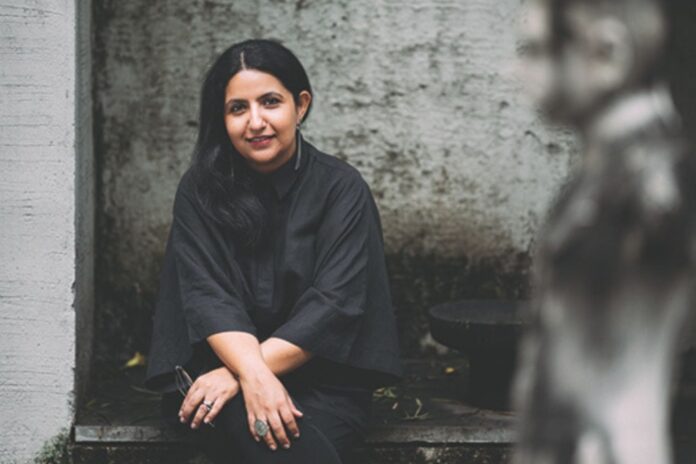
Finding Her Voice in the Language of Craft and Space
Khushnu Panthaki Hoof’s journey into architecture feels almost like a natural evolution rather than a decision. She grew up drawn to the quiet poetry of spaces, fascinated by how light, materials, and textures can shape the way people feel. This instinctive sensitivity eventually led her toward a path where design was not just a discipline, but a way of observing the world.
When she joined Studio Mumbai, the globally acclaimed practice founded by Bijoy Jain, she discovered the perfect environment to grow. Here, the boundaries between architecture, art, and craftsmanship blurred, and Khushnu found her voice in the delicate interplay between structure and atmosphere. Over the years, she evolved into one of the studio’s strongest creative pillars, recognized internationally for her thoughtful approach to design.

Crafting Architecture Through Collaboration
Khushnu’s practice stands apart because she believes architecture is a deeply collaborative act. She works closely with artisans, carpenters, masons, and material specialists — people who carry generations of knowledge in their hands. For her, these craftspeople are not just part of a project team; they are co-authors of the space.
Under her creative leadership, Studio Mumbai developed an approach that rejects the idea of speed or mass-production. Instead, every building is crafted slowly, carefully, and with immense respect for materials. Whether it is stone, wood, or metal, Khushnu encourages the process of “listening” to materials — understanding how they age, how they behave, and how they belong to a landscape.
This philosophy resulted in projects that have traveled the world through exhibitions and publications, showcasing a type of Indian architecture rooted in tradition yet undeniably contemporary.
Shaping Studio Mumbai’s Global Presence
Khushnu played a major role in bringing Studio Mumbai onto the global stage. She was instrumental in organizing exhibitions at leading platforms like the Venice Architecture Biennale, where the studio’s work was celebrated for its honesty, tactility, and deep cultural grounding. These exhibitions made audiences rethink what Indian architecture could be — not only monumental or modern, but intimate, handmade, and slow.
Her curatorial and communicative abilities expanded the studio’s impact far beyond its built work. She articulated its design philosophy to the world with clarity and depth, helping international audiences understand the emotional and ecological intelligence behind each project.
Designing for Quietness, Humanity, and Place
Khushnu’s architectural style is defined by a sense of quiet. Her designs do not shout for attention; they invite you in gently. Whether she is working on a coastal residence, a workshop, or a pavilion, her spaces feel timeless — built with a sensitivity that prioritizes human experience over spectacle.
She is deeply attentive to landscape, climate, and culture. Every project reflects a respect for context rather than an imposition on it. In her work, windows frame wind, walls hold shadows, and courtyards carry silence. It is architecture that breathes.
A Leadership Style Built on Care and Integrity
In a field often driven by ego or speed, Khushnu stands out for her calm presence and grounded leadership. She listens more than she speaks, observes before she decides, and chooses integrity over convenience. Colleagues describe her as someone who brings steadiness to complex processes, clarity to difficult decisions, and empathy to every interaction.
Her leadership continues to inspire young architects who seek to build meaningful work in a world obsessed with efficiency.
A Legacy Defined by Thoughtfulness
Khushnu Panthaki Hoof is more than an architect; she is a custodian of India’s craft traditions, a bridge between old knowledge and new ideas, and a voice for architecture that is slow, deliberate, and deeply human. Her career proves that design does not need to be loud to be powerful — it needs to be honest.
She represents a generation of Indian architects who are redefining global design narratives, not by chasing trends, but by anchoring themselves in values, place, and humanity.

